 A.C. Milan was founded as Milan Cricket and Foot-Ball Club on 13 December 1899 by EnglishAlfred Edwards and Herbert Kilpin,[5]who came from the English city of Nottingham. In honour of its English origins, the club has retained the English spelling of the city's name, as opposed to the Italian spelling Milano, which it was forced to bear under the fascist regime. Milan won its first Italian championship in 1901 and a further two in succession in 1906 and 1907.[2]
In 1908, Milan experienced a split caused by internal disagreements over the signing of foreign players, which led to the forming of another Milan-based team, F.C. Internazionale Milano.[17] Following these events, Milan did not manage to win a single domestic title until 1950–51.[8]The 1950s saw the club return to the top of Italian football, headed by the famous Gre-No-Li Swedish trio Gunnar Gren, Gunnar Nordahl andNils Liedholm. This was one of the club's most successful periods domestically, with the Scudetto going to Milan in 1951, 1955, 1957, 1959 and1962.[8] In 1963, Milan won its first continental title by beating Benfica in the final of the European Cup.[18] This success was repeated in 1969, with a 4–1 win over Ajax in the final, which was followed by the Intercontinental Cup title the same year.[8] During this period Milan also won its first Coppa Italia, with victory over Padova in the 1967 final, and two European Cup Winners' Cups: in 1967–68 and 1972–73.[8]
Milan won a tenth league title in 1979, but after the retirement of Gianni Rivera in the same year, the team went into a period of decline. The club was involved in the 1980 Totonero scandal and as punishment was relegated to Serie B for the first time in its history.[19] The scandal was centred around a betting syndicate paying players and officials to fix the outcome of matches.[19] Milan achieved promotion back to Serie A at the first attempt, winning the 1980–81 Serie B title,[8] but were again relegated a year later as the team ended its 1981–82campaign in third-last place. In 1983, Milan won the Serie B title for the second time in three seasons to return to Serie A,[8]where they achieved a sixth-place finish in 1983–84.
On 20 February 1986, entrepreneur Silvio Berlusconi acquired the club and saved it from bankruptcy after investing vast amounts of money,[2] appointing rising manager Arrigo Sacchi at the helm of the Rossoneri and signing Dutch internationalsRuud Gullit, Marco van Basten and Frank Rijkaard.[2] The Dutch trio added an attacking impetus to the team, and complemented the club's Italian internationals Paolo Maldini, Franco Baresi, Alessandro Costacurta and Roberto Donadoni. Under Sacchi, Milan won its first Scudetto in nine years in the 1987–88 season. The following year, the club won its firstEuropean Cup in two decades, beating Romanian club Steaua București 4–0 in the final. Milan retained their title with a 1–0 win over Benfica a year later and remain the last team to win back-to-back European Cups.[20] The Milan team of 1989–90has been voted the best club side of all time in a global poll of experts conducted by World Soccer magazine.[21]
After Sacchi left Milan in 1991, he was replaced by the club's former player Fabio Capello whose team won three consecutive Serie A titles between 1992 and 1994, a spell which included a 58-match unbeaten run in Serie A[22] and back-to-back UEFA Champions League final appearances in 1993 and 1994. A year after losing 1–0 to Marseille in the 1993 Champions League final, the team reached its peak in one of Milan's most memorable matches of all time, the famous 4–0 win overBarcelona in the 1994 Champions League final.[22] Capello's team went on to win the 1995–96 league title before he left to coach Real Madrid in 1996.[22] In 1998–99, after a two-year period of decline, Milan lifted its 16th championship in the club's centenary season.

Milan's next period of success came under another former player, Carlo Ancelotti. After his appointment in November 2001, Ancelotti took Milan to the 2003 Champions League final, where they defeated Juventus on penalties to win the club's sixth European Cup.[23] The team then won the Scudetto in 2003–04 before reaching the 2005 Champions League final, where they were beaten by Liverpool on penalties despite leading 3–0 at half-time.[23] Two years later, the two teams met again in the 2007 Champions League final, with Milan winning 2–1 to lift the title for a seventh time.[23][24] The team then won its firstFIFA Club World Cup in December 2007.[25] In 2009, after becoming Milan's second longest serving coach with 420 matches overseen,[25] Ancelotti left the club to take over as head-coach at Chelsea.
During this period, the club was involved in the Calciopoli scandal, where five teams were accused of fixing matches by selecting favourable referees.[26] A police inquiry excluded any involvement of Milan managers,[27] but the Italian Football Federation (FIGC) unilaterally decided that it had sufficient evidence to charge Milan vice-president Adriano Galliani. As a result, Milan was initially punished with a 15-point deduction and was banned from the 2006–07 UEFA Champions League. An appeal saw that penalty reduced to eight points,[28] which allowed the club to retain its Champions League participation.
Following the aftermath of Calciopoli, local rivals Internazionale dominated Serie A, winning four Scudetti. However, with the help a strong squad boasting players such as Zlatan Ibrahimović, Robinho and Alexandre Pato joining many of the veterans of the club's mid-decade European successes, Milan recaptured the Scudetto in the 2010–11 Serie A season, their first since the 2003–04 season, and 18th overall.[29][30]
Colours and badge


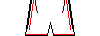

Red and black are the colours which have represented the club throughout its entire history. They were chosen to represent the players' fiery ardor (red) and the opponents' fear to challenge the team (black). Rossoneri, the team's widely used nickname, literally means "the red & blacks" in Italian, in reference to the colours of the stripes on its jersey.[31]
Another nickname derived from the club's colours is the Devil. An image of a red devil was used as Milan's logo at one point with a Golden Star for Sport Excellence located next to it.[32] As is customary in Italian football, the star above the logo was awarded to the club after winning 10 league titles, in 1979. For many years, Milan's badge was simply the Flag of Milan, which was originally the flag of Saint Ambrose.[32] The modern badge used today represents the club colours and the flag of the Comune di Milano, with the acronym ACM at the top and the foundation year (1899) at the bottom.[32]
White shorts and black socks are usually worn as part of the home strip. Milan's away strip has always been completely white.[33] It is considered by both the fans and the club to be a lucky strip in Champions League finals, due to the fact that Milan has won six finals out of eight in an all white strip (losing only to Ajax in 1995 and Liverpool in 2005), and only won one out of three in the home strip. The third strip, which is rarely used, changes yearly, being mostly black with red trimmings in recent seasons.
Stadium
| San Siro | |
 | |
| Location | Via Piccolomini 5, 20151 Milan, Italy |
|---|---|
| Owner | Municipality of Milan |
| Operator | AC Milan and Internazionale |
| Capacity | 80,018 seated |
| Construction | |
| Broke ground | 1925 |
| Opened | 19 September 1926 |
| Renovated | 1939, 1955, 1989 |
| Construction cost | £5,000,000 (1926), £5,100,000 (1939), $60,000,000 (1989) |
| Architect | Ulisse Stacchini (1925), Giancarlo Ragazzi (1989), Enrico Hoffer (1989) |
| Tenants | |
| AC Milan (1926–present), Internazionale(1947–present) | |
For more details on this topic, see San Siro.
Giuseppe Meazza Stadium
The team's stadium is the 80,018 seat San Siro, officially known as Stadio Giuseppe Meazza after the former playerwho represented both Milan and Internazionale. The more commonly used name, "San Siro", is the name of the district where it is located. San Siro has been the home of Milan since 1926, when it was privately built by funding from Milan's president at the time, Piero Pirelli. Construction was performed by 120 workers, and took 13-and-a-half months to complete. The stadium was owned by the club until it was sold to the city council in 1935, and since 1947, it has been shared with Internazionale when the other major Milanese club was accepted as joint tenant.
The first game played at the stadium was on 19 September 1926, when Milan lost 6–3 in a friendly match against Internazionale. Milan played its first league game in San Siro on 19 September 1926, losing 1–2 to Sampierdarenese. From an initial capacity of 35,000 spectators, the stadium has undergone several major renovations, most recently in preparation for the 1990 FIFA World Cup when its capacity was set to 85,700, all covered with a polycarbonate roof. In the summer of 2008 its capacity has been reduced to 80,018, to meet the new standards set by UEFA.
Based on the English model for stadiums, San Siro is specifically designed for football matches, as opposed to many multi-purpose stadiums used in Serie A. It is therefore renowned in Italy for its fantastic atmosphere during matches, largely thanks to the closeness of the stands to the pitch. The frequent use of flares by supporters contributes to the atmosphere but the practice has occasionally caused problems.
AC Milan Emirates Stadium
On 19 December 2005, Milan vice-president and executive director Adriano Galliani announced that the club is seriously working towards a relocation. He said that Milan's new stadium will be largely based on the Veltins-Arena – the home of Schalke 04 in Gelsenkirchen – and will follow the standards of football stadiums in the United States, Germany and Spain. As opposed to many other stadiums in Italy, Milan's new stadium will likely be used for football only, having no athletics track.
On 11 December 2014, Barbara Berlusconi announced a proposal to build a property stadium of 42,000 seats inPortello, behind the new HQ of the Rossoneri, and the large square "Piazza Gino Valle". The new village with shopping malls and hotel is located near CityLife district and is served by the metro.[34]
On 20 September 2015, however, Silvio Berlusconi has called an end to his club's plans to build a new stadium in the city.[35]
Supporters and rivalries

Milan is one of the best supported football clubs in Italy, according to research conducted by Italian newspaper La Repubblica.[36] Historically, Milan was supported by the city's working-class and trade unionists.[37] On the other hand, crosstown rivals Internazionale were mainly supported by the more prosperous and typically Milanese middle-class.[37] One of the oldest ultras groups in all of Italian football, Fossa dei Leoni, originated in Milan.[38] Currently, the main ultras group within the support base is Brigate Rossonere.[38] Politically, Milan ultras have never had any particular preference,[38] but the media traditionally associated them with the left-wing,[39] until recently, when Berlusconi's presidency somewhat altered that view.[40]
According to a study from 2010, Milan is the most supported Italian team in Europe and seventh overall, with over 18.4 million fans.[14] It had the ninth highest average attendance of European football clubs during the 2010–11 season, behindBorussia Dortmund, Barcelona, Manchester United, Real Madrid, Bayern Munich, Schalke 04, Arsenal and Hamburger SV.[41][42][43][44][45]
Genoa fans consider Milan a hated rival after Genoa fan; Vincenzo Spagnolo was stabbed to death by a Milan supporter in January 1995.[46] Milan's main rivalry, however, is with its neighbour club, Internazionale, where both clubs meet in the widely anticipated Derby della Madonnina twice every Serie A season. The name of the derby refers to the Blessed Virgin Mary, whose statue atop the Milan Cathedral is one of the city's main attractions. The match usually creates a lively atmosphere, with numerous (often humorous or offensive) banners unfolded before the start of the game. Flares are commonly present and contribute to the spectacle but they have occasionally led to problems, including the abandonment of the second leg of the 2004–05 Champions League quarter-final match between Milan and Inter on 12 April 2005, after a flare thrown from the crowd by an Inter supporter struck Milan goalkeeper Dida on the shoulder.[47]
Players
First team squad
- As of 21 May 2016.[48]
Note: Flags indicate national team as defined under FIFA eligibility rules. Players may hold more than one non-FIFA nationality.
|
|


For recent transfers, see 2015–16 A.C. Milan season.
Out on loan
Note: Flags indicate national team as defined under FIFA eligibility rules. Players may hold more than one non-FIFA nationality.
|
|


Youth team squad
Further information: A.C. Milan Primavera
Former players
Further information: List of A.C. Milan players and Category:A.C. Milan players
Club captains
Further information: List of A.C. Milan players § Club captains
Player records
Further information: List of A.C. Milan records and statistics
Retired numbers
See also: Retired numbers in association football
| No. | Player | Nationality | Position | Milan debut | Last match | Ref |
|---|---|---|---|---|---|---|
| 3* | Paolo Maldini |  Italy Italy | Centre back / Left back | 25 January 1985 | 31 May 2009 | [72] |
| 6 | Franco Baresi | Italy | Sweeper | 23 April 1978 | 1 June 1997 | [72] |
* Might be restored for one of his two sons, should either of them play professionally for the club.
Current coaching staff
- As of 12 April 2016.[73]
| Position | Name |
|---|---|
| Head coach | Cristian Brocchi |
| Assistant coach | Alessandro Lazzarini |
| Goalkeeping coach | Alfredo Magni |
| Technical assistants | |
| Simone Baldo | |
| Alessandro Lupi | |
| Andrea Pecciarini | |
| Fitness coaches | |
| Bruno Dominici | |
| Pietro Lietti | |
| Medical director | Rodolfo Tavana |
Presidents and managers
Presidential history
Milan has had numerous presidents over the course of its history, some of whom have been owners of the club while others have been honorary presidents. Here is a complete list of them.[74]
|
|
|
Managerial history
Main article: List of A.C. Milan managers
Below is a list of Milan coaches from 1900 until the present day.[75]
|
|


Honours
Milan is one of the most successful clubs in Italy, having won a total of 29 major trophies, and was the most successful club in the world in terms of international trophies until February 2014, when Al Ahly SC claimed that title.[76][77] It is now the third-most successful club behind Real Madrid and Al Ahly with a record of 14 European trophies and four world titles. Milan has earned the right to place a star on its jersey in recognition of the fact that it has won at least ten scudetti. In addition, the club is permanently allowed to display a multiple-winner badge on its shirt as it has won more than five European Championship Cups.[78]
Domestic
League
Cups
European

Worldwide
- FIFA Club World Cup
- Winners (1): 2007
Club statistics and records
For more details on this topic, see List of A.C. Milan records and statistics.

Paolo Maldini holds the records for both total appearances and Serie A appearances for Milan, with 902 official games played in total and 647 in Serie A (as of 31 May 2009, not including playoff matches),[79] the latter being an all-time Serie A record.[80]
Swedish forward Gunnar Nordahl scored 38 goals in the 1950–51 season, 35 of which were in Serie A, setting an Italian football and club record. He went on to become Milan's all-time top goalscorer, scoring 221 goals for the club in 268 games.[81] He is followed in second place by Andriy Shevchenko with 175 goals in 322 games, and Gianni Rivera in third place, who has scored 164 goals in 658 games. Rivera is also Milan's youngest ever goalscorer, scoring in a league match against Juventus at just 17 years.
Legendary tactician Nereo Rocco, the first proponent of catenaccio in the country, was Milan's longest-serving head coach, sitting on the bench for over nine years (in two spells) in the 1960s and early 1970s, winning the club's first European Cup triumphs. Italian Prime Minister Silvio Berlusconi, who purchased the club in 1986, is Milan's longest-serving president (23 years, due to a two-year vacancy between 2004 and 2006).
The first official match in which Milan participated was in the Third Federal Football Championship, the predecessor of Serie A, losing 3–0 to Torinese. Milan's largest ever victory was 13–0 against Audax Modena, in a league match at the 1914–15 season. Its heaviest defeat was recorded in the league at the 1922–23 season, beaten 0–8 by Bologna.
During the 1991–92 season, the club achieved the feature of being the first team to win the Serie A title without losing a single game. Previously, only Perugia had managed to go unbeaten over an entire Serie A season (1978–79), but finished second in the table. In total, Milan's unbeaten streak lasted 58 games, starting with a 0–0 draw against Parma on 26 May 1991 and coincidentally ending with a 1–0 home loss to Parma on 21 March 1993. This is a Serie A record as well as the third-longest unbeaten run in top flight European football, coming in behind Steaua București's record of 104 unbeaten games and Celtic's 68 game unbeaten run.[82][83]
Along with Boca Juniors, Milan has won more FIFA recognised international club titles than any other club in the world.[84]
The sale of Kaká to Real Madrid in 2009 broke the eight-year-old world football transfer record held by Zinedine Zidane, costing the Spanish club €67 million[85](about £56 million[86]). That record, however, lasted for less than a month, broken by Cristiano Ronaldo's £80 million transfer.[87] This record, however, is in terms of nominal British pound rates, not adjusted to inflation or the real value of the euro. Madrid bought Zidane for €75 million in 2001,[88][89] about £46 million at that time.
A.C. Milan as a company
| Year | Result | Turnover |
|---|---|---|
| 2006[90] | 11.904 | 305.111 |
| 2007[91] | −31.7  | 275.442 |
| 2008[92] | −66.8 | 237.9 |
| 2009[93] | −9.8  | 327.6 |
| 2010[94] | −69.751 | 253.196 |
| 2011[95] | −67.334 | 266.811 |
| 2012[96] | −6.9 | 329.3 |
| 2013[97] | −15.7 | 278.7 |
| 2014[98] | −91.3 | 233.6 |
Milan is a subsidiary of Fininvest Group since 1986. As of 31 December 2013, Fininvest owned 99.92973% shares of A.C. Milan SpA.[97] The office of club president has been vacant since 8 May 2008, following a new Italian law that forbids the country's prime minister, Silvio Berlusconi, to have other managing roles in private companies or clubs.[99] The vice-president and CEO of the company is Adriano Galliani. In 2011, Berlusconi became the honorary president of the club, despite stepping down as Italian prime minister.
According to The Football Money League published by consultants Deloitte, in the 2005–06 season, Milan was the fifth-highest earning football club in the world with an estimated revenue of €233.7 million.[100] However, it fell to eighth in 2011–12 season,[101] tenth in 2012–13 and twelfth in 2013–14 season. The club is also ranked as the eighth-wealthiest football club in the world by Forbes magazine as of 2014, making it the wealthiest in Italian football, just surpassing ninth-ranked Juventus by a narrow margin.[15]
Emirates is the current main sponsor for Milan's shirt starting from the 2010–11 season and through to the 2019–20 season.[102] This follows a four-year relationship with Austrian online betting company bwin.com as sponsor.[103]
Previously, German car manufacturer Opel (owned by General Motors) had sponsored Milan for 12 seasons.[104] For most of those 12 years, "Opel" was displayed on the front of the shirt, but in the 2003–04 and the 2005–06 seasons respectively, "Meriva" and "Zafira" (two cars from the company's range) were displayed.
The current shirts are supplied by German sportswear manufacturer Adidas, whose deal runs until 2023.[105] The deal makes Adidas the official manufacturer of all kits, training equipment and replica outfits. Prior to Adidas, the Italian sports company Lotto produced Milan's sportswear.
AC Milan Group made an aggregate net loss in recent year, was one of the largest among the Italian clubs, which: 2005, net loss of €4.5 million (separate account);[106] 2006, a net income of €11.904 million (contributed by the sales of Andriy Shevchenko);[106] 2007, a net loss of €32 million;[107] 2008, a net loss of €77 million;[108] 2009, a net loss of €19 million (contributed by the sales of Kaká);[85] 2010 a net loss of €65 million;[109] 2011 a net loss of €67.334 million,[110] a net loss of €6.857 million in 2012 (contributed by the sales of Thiago Silva and Zlatan Ibrahimović).[96] and a net loss of €15.7 million in 2013 (contributed by the sales ofKevin-Prince Boateng and Alexandre Pato, as well as a decrease in the club's wage bill).
AC Milan had re-capitalization of €75 million in 2007 financial year;[111] €93 million in 2008; €18 million in 2009[112] and €44 million in 2010[113] (€20.9 million of the capital increase was converted from shareholder loan); €87 million in 2011;[114] €29 million in 2012[115] and most recently €3.75 million in 2013.[116] However, the group has had negative equity at the end of each fiscal year since 2006. The balance was €40.8 million in 2006, €47.5 million in 2007, €64.5 million in 2008, €72 million in 2009, €96.6 million in 2010, €77.091 million in 2011, €54.948 million in 2012 and €66.921 million in 2013.
Kit manufacturers and shirt sponsors
| Years | Kit manufacturer | Sponsor | |
|---|---|---|---|
| Brand | Company | ||
| 1981–82 | Linea Milan | Pooh Jeans | Italiana Manifatture S.p.A. |
| 1982–83 | NR | Hitachi | Hitachi Europe Srl |
| 1983–84 | Cuore | ||
| 1984–85 | Rolly Go | Oscar Mondadori | Arnoldo Mondadori Editore S.p.A. |
| 1985–86 | Gianni Rivera | Fotorex U-Bix | Olivetti S.p.A. |
| 1986–87 | Kappa | ||
| 1987–90 | Mediolanum | ||
| 1990–92 | Adidas | ||
| 1992–93 | Motta | ||
| 1993–94 | Lotto | ||
| 1994–98 | Opel | ||
| 1998–06 | Adidas | ||
| 2006–10 | Bwin | ||
| 2010–20 | Emirates | The Emirates Group | |
Superleague Formula
Main article: A.C. Milan (Superleague Formula team)

Milan had a team in the Superleague Formula race car series where teams are sponsored by football clubs. Robert Doornbos, formerly driving for Minardi and Red Bull Racing in the Formula One World Championship, drove for Milan in 2008.[117] Doornbos won his first race for the team at Nürburgring, Germany. Giorgio Pantano is driving for Milan in the 2009 season and he has also won races for the team.[118] The team folded in 2010 along with the series in 2011.
See also


References
- ^ "Organisational chart". acmilan.com. Associazione Calcio Milan. Archived from the original on 7 October 2010. Retrieved 4 October 2010.
- ^ a b c d e f "History". acmilan.com. Associazione Calcio Milan.Archived from the original on 7 October 2010. Retrieved4 October 2010.
- ^ Marotta, Luca (2 May 2016). "AC Milan, Bilancio 2015: i risultati sportivi condizionano negativamente quelli economici".tifosobilanciato.it (in Italian). Retrieved 18 May 2016.
- ^ "Cariche sociali" [Club officers]. acmilan.com (in Italian). Associazione Calcio Milan. Retrieved 7 March 2013.
- ^ a b Neil Heath (17 November 2009). "AC Milan's Nottingham-born hero". bbc.co.uk (British Broadcasting Corporation). Retrieved 4 October 2010.
- ^ Conn, Tom (21 December 2014). "Real Madrid match AC Milan and Boca Juniors with 18 international titles". Inside Spanish Football. Retrieved 22 December 2014.
- ^ "Milan loses the throne. Al Ahly is the most successful club in the world". Football Magazine. 22 February 2014. Retrieved22 December 2014.
- ^ a b c d e f g h i j k "Honours". acmilan.com. Associazione Calcio Milan. Archived from the original on 7 October 2010. Retrieved 4 October 2010.
- ^ "Trophy Room". realmadrid.com. Real Madrid Club de Fútbol. Archived from the original on 12 July 2008. Retrieved12 July 2008.
- ^ "Albo d'oro". legaseriea.it (in Italian). Lega Nazionale Professionisti Serie A. Archived from the original on 18 October 2010. Retrieved 4 October 2010.
- ^ "Struttura". sansiro.net (in Italian). San Siro. Retrieved4 October 2010.
- ^ "Is this the greatest derby in world sports?". Theroar.com.au. 26 January 2010. Retrieved 28 September2011.
- ^ "Italia, il paese nel pallone" (PDF). demos.it (in Italian). 24 September 2010. pp. 3, 9–10. Archived (PDF) from the original on 21 July 2011. Retrieved 20 July 2011.
- ^ a b Ranking of European teams supporters: Barcelona first with 57.8 million, followed by Real Madrid (31.3 million),Manchester United (30.6 million), Chelsea (21.4 million), Bayern Munich (20.7 million) and Milan (18.4 million). "Tifo: Barcellona la regina d'Europa" (in Italian). sportmediaset.mediaset.it. 9 September 2010. Archived from the original on 10 September 2010. Retrieved 10 September 2010. "Calcio, Barcellona club con più tifosi in Europa, Inter 8/a" (in Italian). la Repubblica. 9 September 2010. Retrieved 10 September 2010.
- ^ a b "Soccer Team Valuations". forbes.com (Forbes). 30 April 2008. Archived from the original on 29 September 2010. Retrieved 4 October 2010.
- ^ "ECA Members". ecaeurope.com. European Club Association. Retrieved 4 October 2010.
- ^ "Inter – History". F.C. Internazionale Milano. Archivedfrom the original on 30 January 2010. Retrieved 11 January2010.
- ^ "Champions League 1962/63". acmilan.com. Associazione Calcio Milan. Retrieved 4 October 2010.
- ^ a b Dan Warren (25 July 2006). "The worst scandal of them all". BBC Sport (British Broadcasting Corporation). Retrieved4 October 2010.
- ^ "The great European Cup teams: Milan 1989–90". The Guardian. 24 May 2013. Retrieved 7 June 2013.
- ^ "Brazil's 1970 winning team voted best of all time". Reuters. 9 July 2007. Retrieved 30 September 2011.
- ^ a b c "Fabio Capello". A.C. Milan. Retrieved 7 June 2013.
- ^ a b c "Teams of the Decade #14: Milan 2002–07". Zonal Marking. 22 January 2010. Retrieved 7 June 2013.
- ^ "2006/07: Milan avenge Liverpool defeat". UEFA.Archived from the original on 19 April 2010. Retrieved23 March 2010.
- ^ a b "Carlo Ancelotti". A.C. Milan. Retrieved 7 June 2013.
- ^ "Calciopoli: The sentences in full". Channel 4. 14 July 2006. Archived from the original on 17 July 2007. Retrieved 30 July2006.
- ^ Hughes, Rob (3 October 2006). "Soccer: Odor of corruption from root of game – Sports – International Herald Tribune".International Herald Tribune (London: New York Times). Retrieved 16 May 2011.
- ^ "Punishments cut for Italian clubs". BBC Sport. 25 July 2006. Archived from the original on 22 August 2006. Retrieved 30 July 2006.
- ^ "AC Milan win 2010–11 Serie A title". Goal.com. 7 May 2011. Retrieved 28 September 2011.
- ^ "How AC Milan won the Serie A title". Goal.com. 8 May 2011. Retrieved 28 September 2011.
- ^ "AC Milan – Sevilla FC" (PDF). UEFA.com. 25 July 2007.
- ^ a b c "AC Milan". WeltFussballArchiv.com. 25 July 2007.
- ^ "ADIDAS AND AC MILAN PRESENT 2013-14 AWAY JERSEY". acmilan.com.
- ^ "Ecco il nuovo stadio del Milan Arena da 42 mila posti al Portello". Corriere della Sera. 11 December 2014.
- ^ "AC Milan to stay at San Siro after scrapping plans to build new stadium". espnfc.us. 11 September 2015.
- ^ "Research: Supporters of football clubs in Italy" (in Italian). La Repubblica official website. August 2007.
- ^ a b "AC Milan vs. Inter Milan". FootballDerbies.com. 25 July 2007.
- ^ a b c "Italian Ultras Scene". View from the Terrace. 29 June 2007. Archived from the original on 18 June 2008.
- ^ "AC Milan". SportsPundit.com. 25 July 2007.
- ^ "AC Milan". Extra-Football.com. 25 July 2007. Archived fromthe original on 11 October 2007.
- ^ "German Bundesliga Stats: Team Attendance – 2010–11".ESPNsoccernet.
- ^ "Camp Nou: Average attendance